The speed advantage
This is mostly a conversation with myself.
Speed is the rate at which you cover a distance, complete an action, or carry out a plan. That rate matters. It makes a difference. We all know this, but the real question is this: do we actually move fast?
“Standing still is the fastest way of moving backwards in a rapidly changing world.”
— Lauren Bacall
Why Speed Matters Now
In today’s world, not moving fast should not even be an option. The correct answer to almost anything is changing faster than before. Things are advancing, and certain knowledge is quietly becoming obsolete.
If you listen to futurists, they have been saying for years that change is accelerating. Some suggest that if you are 40 today, by the time you are 60, you may experience what feels like a year of change in just a few months. If you are 10 today, by the time you are 60, that same year of change could feel compressed into days.
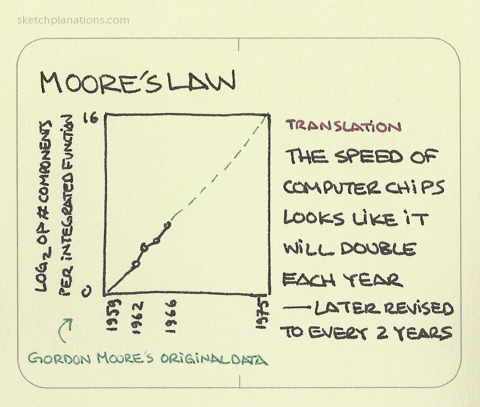 Moore's Law Sketch From sketchplanations.com
Whether the math is exact or not, the point is clear. The way we find answers, build skills, and stay relevant is by increasing our rate of doing.
“Twenty years from now, the rate of change will be four times what it is today. Forty years from now, it will be sixteen times faster.”
— Michael Simmons
Speed, Failure, and Learning
Let me share something practical.
Recently, Steven Bartlett, founder of a $425 million holdings company and the media business behind one of the world’s most listened-to podcasts, The Diary of a CEO, explained that beyond passion and obsession with detail, their real advantage was speed. They ran more experiments. That naturally increased their rate of failure, but over time, it also increased their learning, which allowed them to outpace competitors and rise to the top.
A similar thing happened with Slack, and it shows the real advantage of moving fast. Slack did not start as a messaging app. It began as an internal tool built by a small team working on a failing game called Glitch. When the game struggled, they quickly noticed that the tool they used to talk to each other was more useful than the game itself. Instead of dragging things out, they shut the game down and focused on the tool. They released it early, listened closely to users, and improved it fast. That speed helped Slack grow into a product used by millions and later acquired by Salesforce for $27.7 billion.
Moving fast will not always lead to success. Often, it leads to failure, and that is fine. Failure is feedback. Feedback becomes knowledge. Knowledge is power. In practice, the rate of failure is often close to the rate of success.
So fail fast. Learn that new skill fast. Execute ideas fast. Change direction fast when something is clearly not working. Change that terrible job fast. Change that disturbing lifestyle fast. Just act.
Moving with speed gave me my best clients, my best jobs, and my biggest wins.
When Speed Needs Direction
That said, I have learned that speed without intention can be reckless. When moving fast, fundamentals still matter. Motivation, clarity, attention to detail, direction, and clear goals must be in place. Otherwise, you may move fast and still end up far from where you intended to go.
I am still learning to move faster, and I think we all should move fast with the change.
In my next article, I will write openly about my failures, the simple lessons I learned from them, and how speed shaped my outcomes. Be on the lookout.